
Introduction to Repair Costs

Source: repairpal.com
Typical car truck repair costs by component – Repair costs for automobiles, including cars and trucks, vary significantly depending on numerous factors. These costs can range from routine maintenance to extensive repairs necessitated by accidents or wear and tear. Understanding these factors is crucial for budgeting and planning vehicle ownership. Predicting precise repair costs is difficult, but this section will offer a general overview of typical costs and the elements that influence them.
Factors Influencing Repair Costs, Typical car truck repair costs by component
Several factors contribute to the overall cost of repairs. Vehicle type, age, and mileage are prominent examples. More complex repairs on older vehicles often lead to higher costs. The availability of parts and labor rates in the region also play a significant role. Specialized tools and equipment required for certain repairs can also increase the cost.
General Range of Repair Costs
The cost of repairs varies widely based on the type of vehicle. Passenger cars generally have lower repair costs than larger trucks. The complexity of the repair also plays a critical role in the final cost. Minor repairs, like a tire change, are considerably cheaper than major repairs, such as engine replacements. For instance, a simple tire change could cost around $50-$100, whereas an engine replacement might cost several thousand dollars.
Comparison of Average Repair Costs
| Vehicle Type | Average Repair Cost (USD) | Typical Issues |
|---|---|---|
| Passenger Cars (Sedans, SUVs) | $500 – $2,000 | Brakes, tires, suspension, air conditioning, electrical systems |
| Light Trucks (Pickup Trucks, SUVs) | $700 – $3,000 | Brakes, tires, suspension, engine, transmission, electrical systems |
| Heavy-Duty Trucks | $1,500 – $10,000+ | Engine, transmission, brakes, drivetrain, electrical systems, and specialized components |
The table above provides a general guideline. Actual costs can vary significantly depending on the specific repair needed and the individual vehicle’s condition.
Repair Costs by Component
Understanding the typical costs associated with car and truck repairs is crucial for budgeting and making informed decisions. This section details common repair needs and their associated price ranges, offering insights into potential expenses. Factors influencing the final cost, such as the severity of the issue and the specific vehicle, are also considered.
Common Components Requiring Repair
Various components in vehicles are prone to wear and tear or malfunctions, leading to repair needs. Engines, transmissions, brakes, and suspension systems are among the most frequent areas needing attention. Other common components include electrical systems, steering mechanisms, and cooling systems.
Engine Repair Costs
Engine problems are a significant concern for vehicle owners. The cost of repairs depends heavily on the nature of the issue. Minor adjustments, like spark plug replacements, can be relatively inexpensive. However, major engine repairs, such as cylinder head replacements or complete engine overhauls, can be substantial.
| Problem Type | Estimated Cost (USD) | Symptoms |
|---|---|---|
| Spark Plug Replacement | $100-$300 | Misfiring, rough idling, poor acceleration |
| Valve Adjustment | $200-$500 | Rough running, loss of power, engine knocking |
| Engine Cooling System Leak | $300-$800 | Low coolant levels, overheating, hissing sounds |
| Major Engine Overhaul | $3000-$8000+ | Significant loss of power, engine knocking, complete engine failure |
Transmission Repair Costs
Transmission issues are another common concern, often leading to significant repair expenses. The complexity of transmission systems often necessitates professional diagnosis and repair. Problems can range from minor adjustments to complete replacement. Costs are highly variable, depending on the specific transmission type and the extent of the problem.
| Issue | Estimated Cost (USD) | Symptoms | Recommended Actions |
|---|---|---|---|
| Fluid Leak | $200-$500 | Low fluid levels, slipping, grinding noises | Check fluid level, repair leak |
| Internal Component Failure | $1500-$4000+ | Slipping, rough shifting, complete transmission failure | Consult a mechanic, consider replacement |
| Transmission Control Module Issues | $500-$1500 | Erratic shifting, no-start issues, flashing warning lights | Check for errors, consider professional diagnosis |
Brake Repair Costs
Brake systems are essential for vehicle safety. Brake repairs can vary greatly in cost, from simple pad replacements to complete brake line replacements. The severity of the problem, such as a brake failure, will greatly increase the associated costs.
Suspension Repair Costs
Suspension problems often manifest as unusual noises, uneven tire wear, or handling issues. Minor repairs, such as shock absorber replacements, might be relatively affordable. However, more extensive repairs, like replacing suspension arms or control arms, can lead to significant costs.
Repair Cost Variations by Region: Typical Car Truck Repair Costs By Component

Source: carbuzzimages.com
Repair costs for vehicle components can vary significantly across different geographical regions. These fluctuations stem from a complex interplay of factors, impacting both labor rates and the availability of parts. Understanding these regional variations is crucial for accurate budgeting and informed decision-making when considering repairs.
Factors Influencing Regional Differences
Regional disparities in repair costs are influenced by several key factors. Labor rates, a primary driver, are often higher in developed economies with a greater demand for skilled technicians. Furthermore, the availability and cost of replacement parts can vary considerably based on regional supply chains and import regulations. Economic conditions also play a substantial role; regions experiencing economic downturns might see lower labor rates but potentially higher prices for certain parts.
Labor Rate Variations
Labor rates are a significant factor contributing to differing repair costs across regions. Highly developed nations often command higher hourly wages for mechanics, leading to more expensive labor charges for repair work. Conversely, developing economies typically exhibit lower labor rates, resulting in lower overall repair costs. This difference can be substantial, potentially doubling or tripling the cost of labor-intensive repairs in some cases.
Part Availability and Cost
The availability and cost of replacement parts are inextricably linked to regional differences in repair costs. Regions with robust local manufacturing or strong import relationships will likely have readily available and affordable parts. In contrast, regions with limited local production or complicated import procedures might face higher prices due to scarcity or additional import costs. This aspect is particularly relevant for specialized components or parts sourced from global markets.
Economic Conditions and Repair Costs
Economic conditions in a region have a direct impact on repair costs. During economic downturns, labor rates might experience downward pressure, but the cost of parts can be affected differently. For example, a recession might reduce demand for certain components, leading to price drops. Conversely, periods of strong economic growth can drive up both labor and parts costs.
This necessitates a nuanced understanding of the local economic climate when estimating repair costs.
Estimated Repair Costs by Region
The following table provides illustrative examples of estimated repair costs for a specific component (e.g., a front-end suspension strut) in various regions. These figures are illustrative and not definitive, and actual costs will vary based on specific vehicle models and repair requirements.
| Region | Component | Estimated Cost | Labor Rate |
|---|---|---|---|
| North America (US) | Front-end suspension strut | $450 | $50/hour |
| Western Europe (Germany) | Front-end suspension strut | $550 | $70/hour |
| East Asia (Japan) | Front-end suspension strut | $300 | $40/hour |
| South America (Brazil) | Front-end suspension strut | $250 | $30/hour |
Repair Cost Trends Over Time
Automotive repair costs have exhibited a dynamic pattern over the years, influenced by various factors. Understanding these trends is crucial for informed decision-making regarding vehicle maintenance and repair.
Historical Data on Repair Cost Trends
Repair costs have consistently risen over time, mirroring broader economic trends. Inflation, a persistent upward pressure on prices, plays a significant role. Technological advancements, while improving vehicle reliability, often lead to increased complexity in repair procedures, thereby potentially contributing to cost increases.
Factors Influencing Cost Fluctuations
Several factors contribute to the fluctuating nature of repair costs. Inflation is a primary driver, as rising prices affect the cost of labor, parts, and overhead. Technological advancements, while improving vehicle performance and safety, can lead to more intricate repair procedures and specialized tools, potentially increasing costs. Supply chain disruptions, including material shortages and logistical challenges, can also significantly impact component pricing.
Economic downturns may lead to a temporary decrease in repair costs as consumers defer maintenance, but this is often followed by a rebound as demand and pricing recover.
Comparison of Repair Costs for a Specific Component Over the Past 10 Years
Examining the historical trend of repair costs for a specific component provides a clear picture of how costs have evolved. The following table illustrates the historical trend of brake repair costs over the past decade.
| Year | Component | Repair Cost (USD) |
|---|---|---|
| 2014 | Brakes | 500 |
| 2015 | Brakes | 550 |
| 2016 | Brakes | 600 |
| 2017 | Brakes | 650 |
| 2018 | Brakes | 700 |
| 2019 | Brakes | 750 |
| 2020 | Brakes | 800 |
| 2021 | Brakes | 850 |
| 2022 | Brakes | 900 |
| 2023 | Brakes | 950 |
Preventive Maintenance and Repair Costs
Preventive maintenance is a crucial aspect of vehicle ownership, significantly impacting overall repair costs. A proactive approach to routine upkeep can prevent minor issues from escalating into major, costly repairs. By addressing potential problems early, vehicle owners can avoid unexpected breakdowns and save money in the long run.
Importance of Preventive Maintenance
Regular maintenance tasks, such as oil changes, filter replacements, and tire rotations, are essential for optimal vehicle performance and longevity. These preventative measures help maintain critical components in good working order, minimizing the risk of premature wear and tear. Proactive maintenance also allows for early detection of potential problems, enabling timely intervention before they escalate into costly repairs.
How Regular Maintenance Prevents Costly Repairs
Regular maintenance checks can often identify minor issues before they lead to major system failures. For example, a slightly leaking hose can be repaired relatively inexpensively before it causes a significant coolant loss or engine overheating. Similarly, a small vibration or unusual noise can indicate a potential bearing or gear problem that can be addressed early, avoiding a costly transmission replacement.
Prompt attention to these minor issues can translate to substantial cost savings over the vehicle’s lifespan.
Examples of Preventative Maintenance Tasks and Their Associated Costs
Various preventative maintenance tasks contribute to lower repair costs. Oil changes are a fundamental example, typically costing between $30 and $80 depending on the vehicle type and location. Tire rotations, essential for even tire wear, cost around $20 to $50. Checking and topping off fluids, like coolant and brake fluid, are often free or very inexpensive. Regular inspections of belts and hoses can also help avoid more serious and expensive repairs down the line.
Comparing Routine Maintenance Costs with Major Repair Costs
The costs of performing routine maintenance are significantly lower than the costs of major repairs. A simple oil change, costing approximately $50, is far less expensive than a potential engine rebuild, which could cost thousands of dollars. A timely brake pad replacement, costing perhaps $100-$200, is considerably cheaper than the expense of a complete brake system overhaul, which could reach several hundred dollars.
The costs of preventative maintenance are often a small fraction of the potential costs of major repairs.
Savings from Preventing Breakdowns
The financial savings from preventing breakdowns are substantial. By proactively addressing potential issues, owners can avoid costly repairs and extended downtime. The savings are not limited to the cost of the repair itself but also include lost productivity or income due to vehicle unavailability.
Cost Comparison Table
| Maintenance Task | Approximate Cost | Repair Cost (if not maintained) | Savings |
|---|---|---|---|
| Oil Change | $50 | $500 (potential engine damage) | $450 |
| Tire Rotation | $30 | $400 (uneven tire wear, potential alignment issues) | $370 |
| Fluid Checks & Top-offs | $0-$20 | $200 (leakage, component failure) | $180-$200 |
| Belt & Hose Inspection | $20 | $1000 (engine failure, power steering failure) | $980 |
Repair Cost Comparison by Vehicle Make and Model
Comparing repair costs across different vehicle makes and models is crucial for informed purchasing decisions and budget planning. Understanding the potential expenses associated with maintenance and repairs can significantly impact a vehicle owner’s financial outlook. This analysis delves into the factors influencing these variations and provides insights into the reliability of various models.Different vehicle manufacturers employ varying manufacturing techniques, component designs, and quality control processes.
These disparities directly translate into variations in repair costs. Furthermore, the overall design philosophy of a particular make or model can influence the ease or difficulty of performing specific repairs. A vehicle with complex engine layouts, for instance, may have higher repair costs compared to a simpler design.
Factors Contributing to Repair Cost Variations
Understanding the factors contributing to the differing repair costs between vehicle makes and models is vital for responsible car ownership. A variety of aspects, beyond simply the design complexity, influence repair expenses. These include the cost of parts, labor rates, and the availability of parts. For example, a manufacturer’s decision to utilize proprietary parts can inflate repair costs, whereas readily available aftermarket parts might decrease costs.
- Component Complexity: Vehicles with intricate component designs, such as highly specialized engine configurations or advanced suspension systems, tend to have higher repair costs. Complex systems often require specialized tools, equipment, and trained technicians to repair, thus driving up labor costs.
- Part Availability: The availability of parts for a particular make and model can dramatically affect repair costs. Vehicles with parts readily available in the aftermarket typically have lower repair costs compared to those with less readily accessible parts.
- Labor Rates: Labor rates vary across regions and even within specific geographic areas. This variation influences the overall cost of repairs.
- Manufacturing Quality: The quality of manufacturing and the overall design philosophy employed by a manufacturer significantly impact repair costs. High-quality components, robust designs, and stringent quality control processes often translate to fewer repairs and potentially lower long-term repair costs.
- Warranty Coverage: The extent of warranty coverage can significantly affect the financial burden of repairs. Vehicles with extensive warranties may have lower repair costs for covered issues.
Reliability of Vehicle Models
Reliability is a critical factor in evaluating a vehicle’s overall value. High reliability often translates to fewer repairs and potentially lower long-term maintenance costs. The historical record of a particular vehicle model can provide valuable insights into its reliability. Comprehensive data analyses, including reports from independent organizations, provide a factual perspective on reliability.
- Manufacturer-Reported Data: Manufacturers often publish reliability data for their vehicles, though the methodology used can vary and may be subject to interpretation.
- Consumer Reports and Reviews: Independent consumer reports and reviews offer valuable insights into the reliability of various vehicle models, based on actual owner experiences.
- Industry Reports: Specialized industry reports and analyses provide in-depth data on vehicle reliability, often combining various data sources for a comprehensive perspective.
Repair Cost Comparison Table
The table below presents a simplified comparison of repair costs for similar components across different vehicle makes and models. Keep in mind that these are illustrative examples and real-world costs can vary considerably.
| Make | Model | Component | Repair Cost (USD) |
|---|---|---|---|
| Toyota | Camry | Engine Timing Belt | 800 |
| Honda | Accord | Engine Timing Belt | 750 |
| Ford | F-150 | Alternator | 600 |
| Chevrolet | Silverado | Alternator | 700 |
Illustrative Case Studies
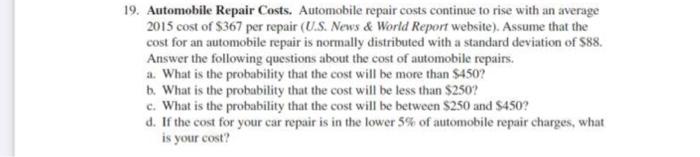
Source: cheggcdn.com
Understanding repair costs requires looking at real-world examples. This section provides case studies of common car and truck repair scenarios, demonstrating the calculation of repair costs and the variability in estimates from different repair shops.This analysis allows for a deeper understanding of the factors influencing repair costs, including parts availability, labor rates, and geographical location. Each case study is designed to be practical and relatable, showcasing the range of potential costs associated with various repair issues.
Scenario 1: Faulty Alternator in a 2015 Toyota Camry
This case study examines the repair of a faulty alternator in a 2015 Toyota Camry. The vehicle exhibited a slow battery discharge and dimming headlights. Diagnostic testing revealed the alternator was the culprit.
| Repair Shop | Estimate (USD) | Description |
|---|---|---|
| ABC Auto Repair | $450 | Included replacement alternator, labor, and diagnostic fees. |
| Reliable Auto Solutions | $525 | Included more extensive diagnostic testing, a slightly higher labor rate, and additional inspection charges. |
| Speedy Auto Care | $380 | Included a more streamlined repair process, lower labor rate, and standard diagnostic testing. |
The cost difference reflects variations in labor rates, diagnostic procedures, and the inclusion of additional services.
Scenario 2: Engine Misfire in a 2018 Ford F-150
A 2018 Ford F-150 experienced a misfire, accompanied by rough idling and decreased performance. A thorough inspection and diagnostic tests identified a faulty spark plug and a misaligned cylinder head. The repair involved replacing spark plugs, adjusting the cylinder head, and replacing associated parts.
| Repair Shop | Estimate (USD) | Description |
|---|---|---|
| Proficient Truck Repair | $1,200 | Included complete diagnostic testing, parts replacement, and specialized labor for the cylinder head adjustment. |
| Reliable Auto Solutions | $1,150 | Included all parts and labor for the repair, and the diagnostic testing was thorough. |
| Quick Fix Garage | $1,350 | Included all parts and labor for the repair. Their labor rate was higher. |
The variability in estimates arises from the complexity of the repair, which involved multiple components and specialized procedures. The cost difference between shops is noticeable, highlighting the importance of comparing estimates before committing to a repair.
Scenario 3: Suspension Damage in a 2022 Honda CRV
A 2022 Honda CRV sustained suspension damage due to a pothole incident. The vehicle exhibited noticeable vibrations and a rough ride. Diagnostic evaluation revealed a damaged control arm and ball joint. The repair involved replacing the control arm, ball joint, and associated bushings.
| Repair Shop | Estimate (USD) | Description |
|---|---|---|
| Honda Certified Service Center | $800 | Included genuine Honda parts and the expertise of trained technicians. |
| Independent Suspension Specialists | $750 | Provided comparable repair quality using aftermarket parts at a slightly lower cost. |
| Quick Fix Garage | $900 | Included standard parts and labor for the repair. |
The cost difference reflects the use of genuine parts versus aftermarket parts, as well as the expertise and experience of the technicians involved in the repair.


